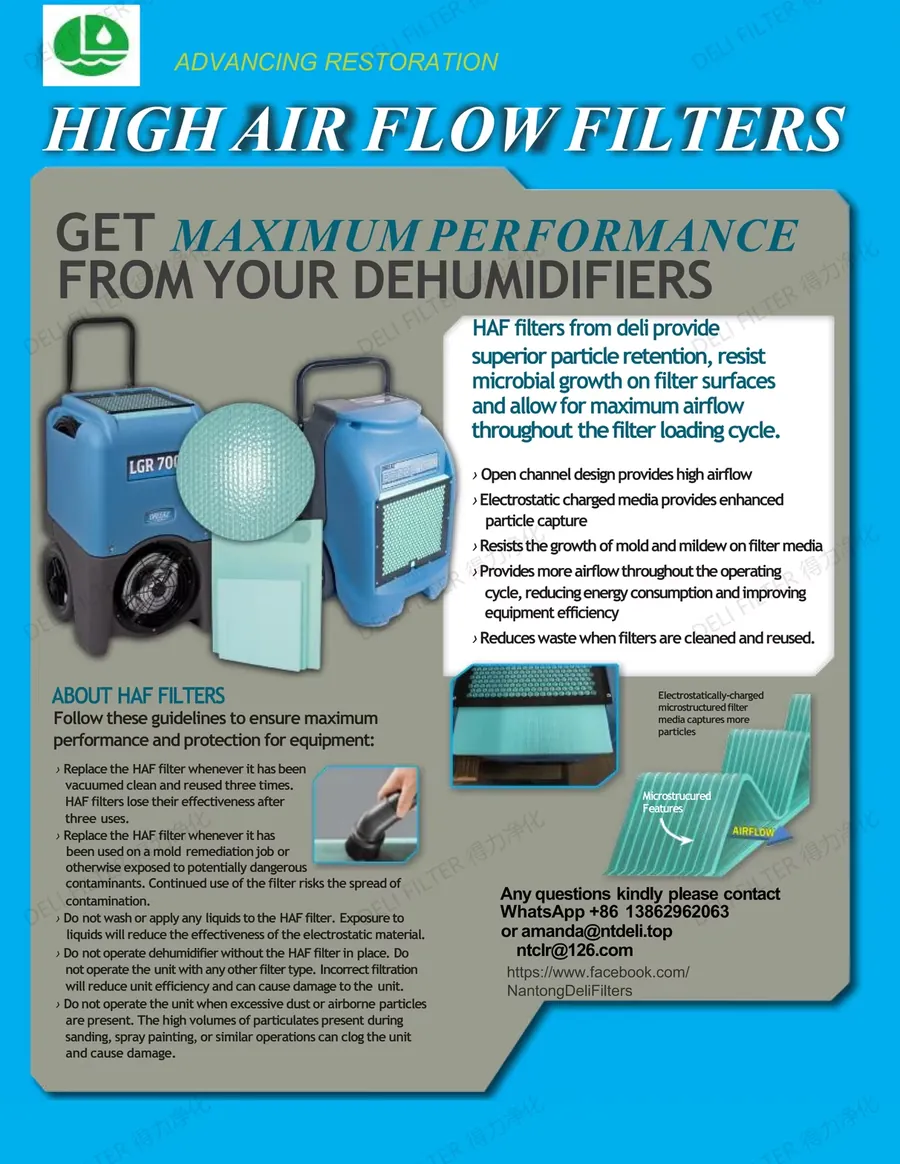
In the professional water damage restoration industry, equipment uptime and drying speed are everything. If you are operating a Low Grain Refrigerant (LGR) dehumidifier like the Dri-Eaz LGR 700 or Phoenix series, you have likely encountered the term "HAF filter."
But what makes an HAF (High Air Flow) filter different from a standard pleated furnace filter, and why does using the wrong one actually cost you money in equipment repairs and job site efficiency?
1. The Microstructure Difference
Standard pleated filters rely on "mechanical filtration." They use a dense web of fibers to physically block particles. As the filter loads with dust, the spaces between the fibers close up, making it harder for air to pass through.
HAF filters, like those manufactured by Nantong Deli, use a unique open-channel microstructure. Instead of a dense web, the air flows through clear channels. This design inherently has a much lower initial pressure drop than a pleated filter of similar efficiency.
2. Electrostatic vs. Mechanical Capture
If the channels are open, how does the filter actually trap dust? The secret is a permanent electrostatic charge. The HAF media is charged to act like a magnet, pulling dust, allergens, and mold spores out of the airstream and bonding them to the channel walls.
"Using a standard high-MERV pleated filter in an LGR dehumidifier is like trying to breathe through a wet towel. It might clean the air, but the machine is starving for volume."
3. Protecting the LGR Coils
An LGR dehumidifier works by cooling air below its dew point. To do this efficiently, it requires a precise volume of air to cross the cooling coils. If airflow is restricted by a standard filter:
- The compressor works harder and runs hotter.
- The coils can ice up, causing the unit to shut down or leak.
- Water removal rates (Pints Per Day) drop significantly.
| Feature | HAF Filter | Standard Pleated |
|---|---|---|
| Airflow (CFM) | Very High (Open Channel) | Low to Moderate |
| Capture Method | Electrostatic Charge | Mechanical Sieve |
| Pressure Drop | Stays low as it loads | Increases rapidly as it loads |
| Maintenance | Disposable (Replace) | Disposable |
| Best For | LGR Dehumidifiers, Air Movers | Residential HVAC |
4. Pressure Drop Data: HAF vs. Standard Filters at 250 CFM
The single most important number when selecting a filter for an LGR dehumidifier is static pressure drop at rated airflow. Here is how HAF open-channel electrostatic media compares to common standard filter types at 250 CFM — a typical LGR operational flow rate:
| Filter Type | Pressure Drop (New) | Pressure Drop (50% Loaded) | CFM Maintained at 50% Load |
|---|---|---|---|
| HAF Open-Channel Electrostatic | 0.08–0.12 in. w.c. | 0.10–0.15 in. w.c. | ≥95% of rated |
| Fiberglass Panel (MERV 1–4) | 0.04–0.08 in. w.c. | 0.15–0.25 in. w.c. | ~85% |
| Pleated Polyester (MERV 8) | 0.18–0.30 in. w.c. | 0.40–0.65 in. w.c. | ~70% |
| Pleated High-Efficiency (MERV 11–13) | 0.35–0.55 in. w.c. | 0.80–1.20 in. w.c. | <55% |
At 50% filter loading, a MERV 8 pleated filter in an LGR dehumidifier can drop delivered airflow to 70% of rated — meaning your machine is removing water at roughly 70% efficiency while running at full power consumption. That is a significant hidden operating cost on multi-week restoration jobs.
5. The Real Cost Calculation: Filter vs. Equipment
Restoration contractors often ask whether premium HAF filters are worth the extra cost over cheap panel filters. The math is straightforward:
- A quality HAF filter (OEM-equivalent): \$3–8 per unit wholesale from a verified China manufacturer
- LGR dehumidifier compressor replacement: \$400–1,200 per unit
- Lost job revenue from a coil-iced unit: varies, but typically \$500–2,000+ in delays and re-mobilization
Using an incorrect filter to save \$2–5 per unit risks a repair bill that is 100× larger. Across a fleet of 10–20 LGR units, the correct filter specification is a procurement decision with real financial consequences.
6. How to Identify a Genuine HAF-Spec Filter
Not all "open-mesh" or "electrostatic" filters sold online meet the HAF specification required for professional LGR dehumidifiers. When evaluating a source, check for:
- Media type: Low-density electrostatically charged synthetic fiber — not polyester batting or fiberglass
- Open-channel structure: Air should pass through visible parallel channels, not a flat sheet of fiber
- Pressure drop certification: Supplier should be able to provide test data showing <0.15 in. w.c. at 250 CFM
- Dimensional accuracy: Frame dimensions should be within ±1mm of OEM spec to ensure sealed fit in the filter housing
- Antimicrobial treatment: Standard for restoration environments where mold and bacteria are present
7. The Cost of Washing
A common mistake in the field is attempting to wash HAF filters to save on replacement costs. Do not do this. Water and detergents neutralize the electrostatic charge. A washed HAF filter will look clean, but it will no longer "magnetize" the dust. The particles will pass straight through the open channels and coat your expensive dehumidifier coils in grime.
The economics of washing also do not favor it: a \$4–6 HAF filter replacement is far cheaper than the labor and downtime involved in professionally cleaning dehumidifier coils after contamination.
8. Sourcing HAF Filters: OEM vs. Factory-Direct China
Major restoration equipment brands (Dri-Eaz, Phoenix, AlorAir) all source their HAF filter media from third-party manufacturers — most of them in China. When you buy "OEM" branded HAF filters through a US distributor, you are typically paying a 3–5× markup on a product manufactured in Jiangsu, Guangdong, or Zhejiang province.
Factory-direct sourcing from a certified Chinese manufacturer like Nantong Deli (ISO 9001:2015 certified since 2005, Bureau Veritas audited November 2025) allows restoration distributors and fleet operators to:
- Reduce per-unit filter cost by 40–70%
- Get custom dimensions for non-standard dehumidifier models
- Access private-label and OEM branding options
- Maintain consistent quality through documented quality management systems
Minimum order quantities for HAF filters from Nantong Deli start at 300–500 units with a 7-day sample lead time. Contact amanda@ntdeli.top for specs and pricing.
Conclusion
For restoration professionals, the HAF filter is a small investment that protects a multi-thousand dollar piece of equipment. The open-channel electrostatic design maintains rated airflow throughout the filter's service life — something no standard pleated filter can do at LGR operational CFM levels.
By choosing a high-quality OEM-equivalent HAF filter from a verified HAF filter manufacturer in China like Nantong Deli, you ensure your LGR dehumidifiers operate at peak rated capacity, job after job, with a full supply chain audit trail behind every batch.
Frequently Asked Questions
- Can I use a MERV 8 filter in a Dri-Eaz LGR 700?
- No. The pressure drop at 250 CFM is typically 0.40–0.65 in. w.c. at 50% load — 4–5× the HAF spec. This causes coil icing, compressor overload, and significantly reduced pints-per-day output.
- How often should HAF filters be replaced in active restoration?
- Every 1–3 weeks in Category 2–3 water damage environments. Every 30–60 days in lighter commercial use. Monitor airflow — reduced output is the primary indicator.
- Are China-manufactured HAF filters the same quality as OEM?
- Major brands source their HAF media from China already. A factory-direct supplier with ISO 9001:2015 certification and third-party audit documentation (Bureau Veritas, SGS) can provide equivalent or superior quality at significantly lower cost.
View Our HAF Filter Product Line →