HAF Filter LGR 700 Replacement Guide — What Restoration Pros Need to Know
If you run an LGR dehumidifier on a water damage restoration job, your HAF filter is one of the most critical — and most overlooked — maintenance items on the machine. This guide covers everything: what HAF filters actually do, when to replace them, how to identify the right replacement, and how to source them at scale if you run a fleet.
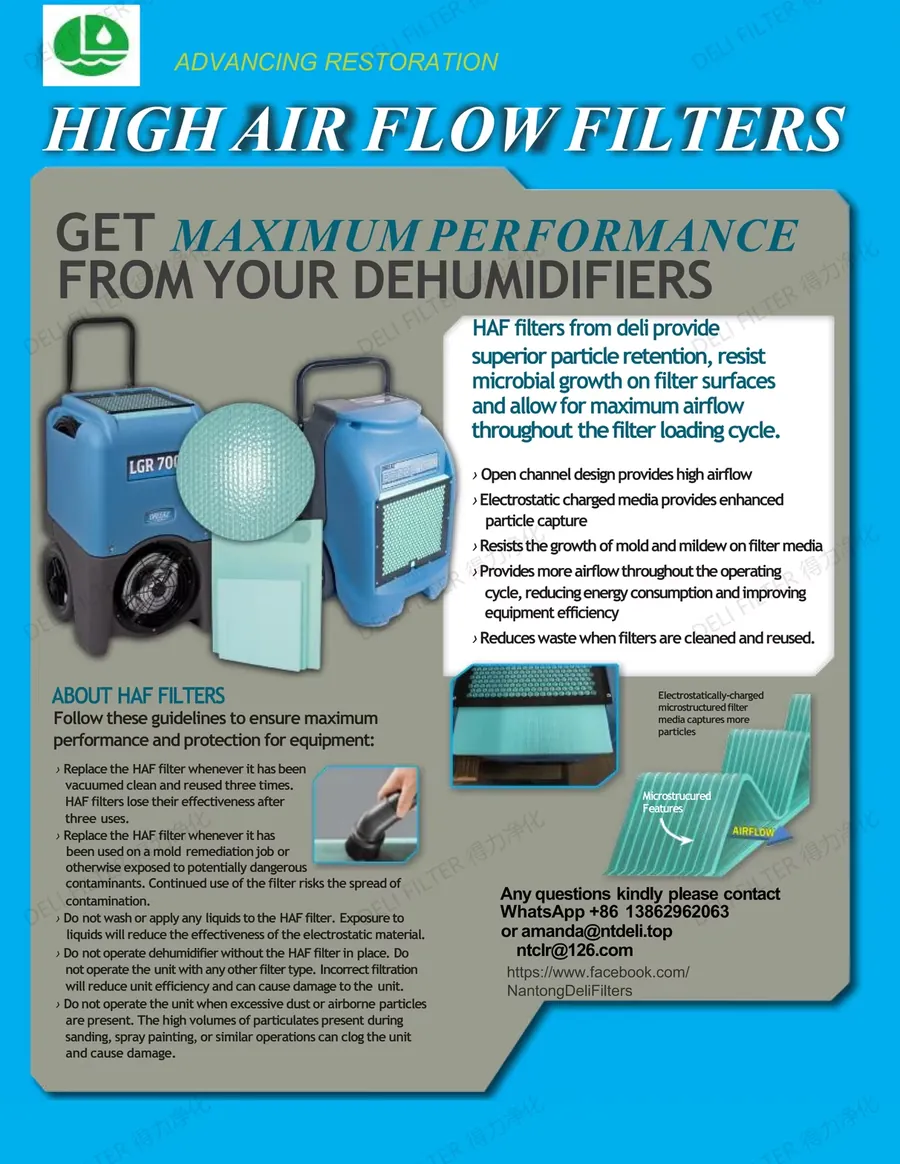
1. What Is a HAF Filter — and Why It Matters
HAF stands for High Air Flow. It is the primary intake filter on professional LGR (Low Grain Refrigerant) dehumidifiers, including the widely-used LGR 700 series and compatible units from Dri-Eaz, Phoenix, and similar brands.
Unlike standard HVAC filters that prioritize particle capture over airflow, HAF filters are engineered for a specific balance: maximum airflow with adequate particle protection. This matters because LGR dehumidifiers pull enormous volumes of air through the machine — typically 100–300 CFM — to achieve their moisture-removal rates. Restrict that airflow and you reduce the machine's dehumidification capacity directly.
The most common mistake restoration companies make is using a standard HVAC filter as a replacement. Standard filters have too high a pressure drop, which starves the machine of airflow and reduces its effective grain-per-hour output by 15–30%.
How HAF Filter Media Works
HAF filters use electrostatic charged microstructured media. This means the fibers carry a passive electrostatic charge that attracts particles — dust, debris, mold spores — without adding significant airflow resistance. The open-channel pleated design maintains low pressure drop even as the filter loads with debris.
2. When to Replace Your LGR 700 HAF Filter
There is no universal interval because conditions on restoration jobs vary enormously. A filter used on a clean residential water loss lasts much longer than one used after a sewage backup or a fire-and-water event.
General Replacement Guidelines
| Condition | Recommended Interval | Notes |
|---|---|---|
| Clean residential water loss (Category 1) | Every 200–300 operating hours | Standard interval; inspect monthly |
| Grey water / Category 2 | Every 100–150 operating hours | Higher debris and microbial load |
| Black water / Category 3 / sewage | After each job | Never reuse — microbial contamination risk |
| Fire + water (smoke and soot present) | Every 50–80 operating hours | Soot clogs electrostatic media quickly |
| Construction / demo dust present | Every 75–100 hours | Drywall and concrete dust are very fine |
Signs Your HAF Filter Needs Immediate Replacement
- Reduced airflow: The machine sounds different — higher pitch or lower-than-normal airflow from the exhaust
- Lower than expected pints-per-day output: If the machine is underperforming its rated capacity in similar humidity conditions, check the filter first
- Visible loading: If you can see significant debris on the filter face, it is time to replace
- Odor from the unit: Microbial growth on a saturated filter can produce odors that the machine then distributes into the work area
HAF filters rely on electrostatic charge to capture particles efficiently. Washing — even with clean water — permanently destroys this charge. A washed HAF filter has a fraction of its original particle capture efficiency. Always replace, never wash.
3. Compatible Models & Part Numbers
The LGR 700 is manufactured by several brands. Each uses a HAF filter with slightly different dimensions. Here are the most common:
| Unit | OEM Part Number | Filter Dimensions (approx.) | Notes |
|---|---|---|---|
| Dri-Eaz LGR 700 | F368 | Check unit label | Most common LGR 700 filter |
| Dri-Eaz LGR 2000i | F474 | Check unit label | Larger unit — different filter size |
| Phoenix R250 | 4029920 | Check unit label | Phoenix-branded HAF media |
| Phoenix Guardian LGR | Contact manufacturer | Check unit label | Custom size — measure before ordering |
| Dri-Pod / Compact LGR units | Varies by model | Smaller format | Always measure actual filter slot |
OEM part numbers are a guide, but dimensions can vary between production runs. Measure the filter slot (length × width × depth) before ordering in bulk. This is especially important when sourcing aftermarket or OEM-manufactured replacements.
4. HAF Filter Technical Specifications
When evaluating HAF filter replacements — OEM or aftermarket — these are the specifications that matter:
| Media Type | Electrostatic charged synthetic microfiber |
| Frame Material | High-density cardboard or polypropylene (moisture-resistant) |
| Pleat Design | Open-channel (maintains low pressure drop under load) |
| Microbial Resistance | Anti-mold surface treatment on media fibers |
| Washability | Not washable — electrostatic charge is permanent but fragile |
| Typical Pressure Drop (clean) | Low — must not significantly restrict rated CFM |
| Custom Sizing | Available from OEM manufacturers for fleet operators |
5. Sourcing HAF Filters at Scale — OEM vs. OEM Aftermarket
For restoration companies running 10, 50, or 100+ units, filter costs add up fast. There are three sourcing paths:
Option 1: Direct from Equipment Manufacturer
Dri-Eaz, Phoenix, and others sell replacement filters directly. Highest price — you are paying for the brand name. Lead times can be long if the item is out of stock.
Option 2: Distributor / Restoration Supply Shops
US restoration equipment distributors (Jon-Don, Contractors Direct, etc.) stock popular HAF filters. Convenient but mid-to-high pricing. Stock levels vary.
Option 3: OEM Manufacturer Direct (Best for Fleet Operators)
This is where fleet operators gain a significant cost advantage. OEM filter manufacturers — factories that actually produce the filter media and frames — can supply HAF filters built to your exact specification at 30–60% lower cost than branded equivalents.
Key advantages of going direct to an OEM manufacturer:
- Custom dimensions: Exact fit for your specific unit models — no compromise
- Private labeling: Your company's branding on the filter and packaging
- Bulk pricing: Significant per-unit savings at MOQs of 500+ pieces
- Consistent supply: Direct factory relationship means no distributor stock-outs
- Spec control: You approve the media, frame, and pressure drop specs before production
We supply HAF dehumidifier filters to HVAC distributors and restoration equipment companies in the US, UK, and EU. ISO 9001 certified, 53 authorized patents (incl. 3 utility patents for proprietary filter technology), custom sizing available. Free samples for qualified buyers — lead time 7 days. Request a sample →
6. HAF Filter Maintenance Best Practices for Fleet Operators
Build a Filter Replacement Schedule
Track operating hours per unit using the machine's hour meter (most LGR units have one). Set replacement triggers at your chosen interval — 200 hours for Category 1 conditions — and stick to it proactively rather than waiting for performance drops.
Keep Spare Filters on Every Job Truck
A single filter failure mid-job extends the drying time and risks mold growth. Carry at least two spare HAF filters per unit on every truck. The cost of carrying spares is far lower than the cost of a failed job.
Inspect at Every Job Setup
Before powering on the unit at a new job, check the filter. 30 seconds of inspection can prevent a 4-hour underperformance problem you might not notice until the job fails moisture readings.
Dispose Properly on Contaminated Jobs
Filters from Category 2 and 3 jobs should be bagged and disposed of as contaminated waste — not shaken out or left in the unit. A contaminated filter that dries out and is reused on the next job can cross-contaminate a clean site.
7. Frequently Asked Questions
Related Reading
-
HAF Dehumidifier Filter — OEM Manufacturer
Factory-direct HAF replacement filters for Dri-Eaz LGR 700, Phoenix R200S, AlorAir and more.
-
HAF Filters for Water Damage Restoration: The LGR Fleet Guide
Fleet management, replacement intervals and bulk sourcing strategy for restoration contractors.
-
What Is an HAF Filter — and Why You Should Never Wash One
The definitive explainer on HAF filter media, electrostatic charging and why washing destroys performance.
Need HAF Filters for Your Fleet?
30-year OEM manufacturer. Custom sizes, ISO 9001, anti-mold treatment, fast samples. Serving restoration equipment distributors in the US, UK, and EU.
Request Free Samples → WhatsApp Us →