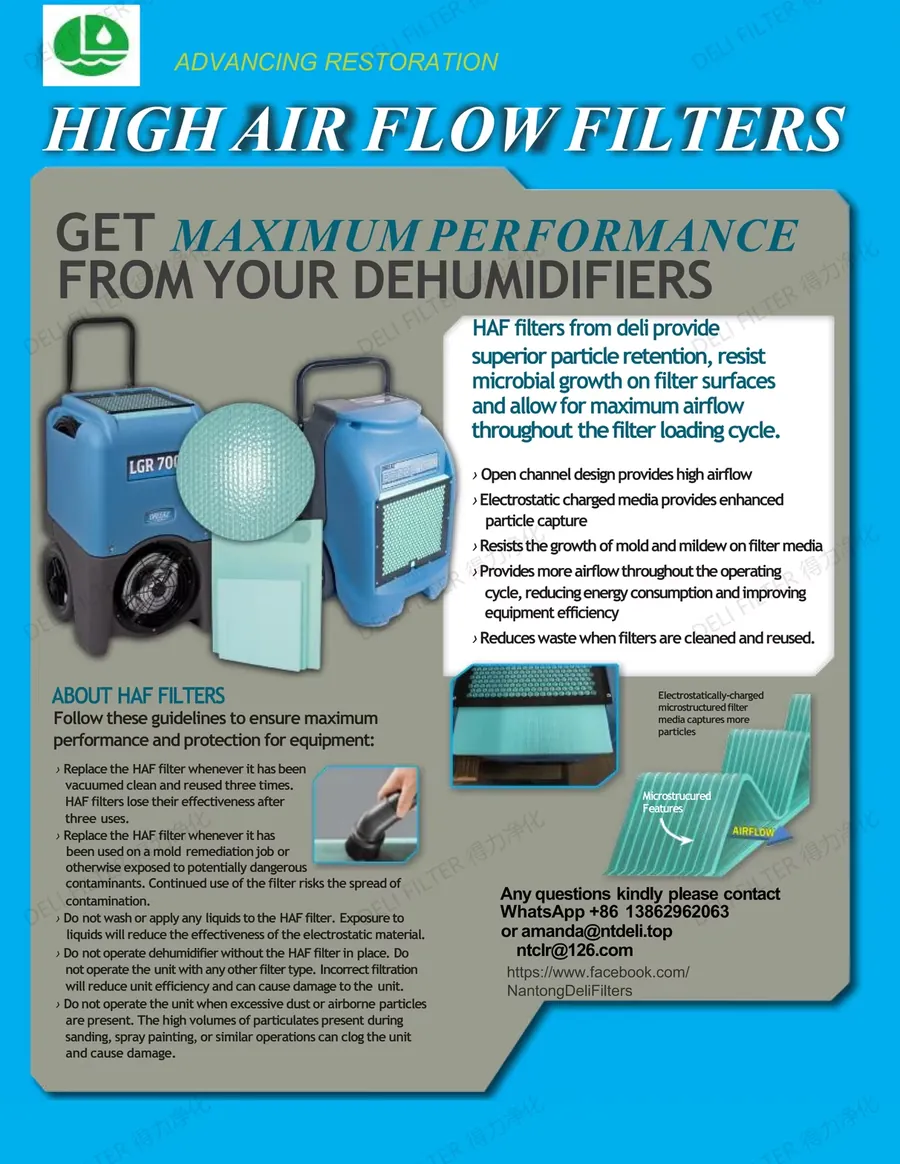
In the world of high-performance air drying, one component stands between your expensive equipment and a costly breakdown: the HAF filter. Whether you are running a fleet of Dri-Eaz units or Phoenix dehumidifiers, understanding the technology behind these filters is essential for maintaining equipment longevity.
1. What Does HAF Stand For?
HAF stands for High Air Flow. Unlike traditional pleated filters that use a dense "web" of fibers to physically block particles, HAF filters are designed with an open-channel microstructure. This design is the polar opposite of a high-MERV residential pleated filter, which often acts as a bottleneck for air volume.
In professional restoration, the goal is to move as much air as possible across the dehumidifier's cooling coils. Any restriction in airflow reduces the efficiency of the refrigeration cycle, meaning your machine removes fewer pints of water per day.
2. How Do HAF Filters Work?
You might wonder: if the channels are "open," how does the filter actually trap dust? The secret lies in two specific engineering choices:
Open-Channel Media
The media is structured into rows of channels that allow air to pass through with incredibly low resistance (low pressure drop). This ensures your dehumidifier's blower motor isn't strained and the compressor remains within its safe operating temperature.
Permanent Electrostatic Charge
During the manufacturing process at Nantong Deli, the HAF media is given a permanent electrostatic charge. This charge makes the channel walls act like a magnet. As dust, mold spores, and debris enter the channels, they are pulled out of the airstream and bonded to the walls. This allows the filter to capture significant amounts of contaminants without clogging as quickly as a mechanical filter.
3. Why You Must Never Wash an HAF Filter
It is tempting to take a vacuum or a hose to a dirty HAF filter to save a few dollars. However, washing an HAF filter permanently destroys it.
While the filter might look clean after washing, the water and detergents neutralize the electrostatic charge. Once that charge is gone, the filter loses its "magnetic" properties. Because the channels are open, the dust will simply fly straight through the filter and land on your dehumidifier's evaporator coils. This leads to "slugging," reduced cooling efficiency, and eventually, a total system failure that requires expensive professional cleaning.
4. HAF Filter Compatibility — LGR 700, Dri-Eaz & More
Compatibility is critical for field technicians. High-quality HAF replacements are designed to fit precisely into the filter slots of leading restoration equipment. Standard sizes manufactured by Nantong Deli are compatible with:
- Dri-Eaz: LGR 700, LGR 2800i, LGR 3500i, and the Dri-Pod.
- Phoenix: Various LGR models and air movers.
- Legend Brands: A wide range of professional drying equipment.
Using a properly fitted HAF filter ensures that no "bypass air" (unfiltered air) leaks around the edges of the filter frame.
5. Sourcing HAF Filters from an OEM Manufacturer
When you source HAF filters directly from an OEM HAF filter manufacturer in China like Nantong Deli, you aren't just getting a generic replacement. You are getting media that has been tested for precise electrostatic retention and airflow velocity.
With over 30 years of experience and 53 authorized patents, our R&D team—led by PhD specialists—ensures that every batch of HAF media meets the rigorous demands of the US and European restoration markets.
Related Reading
-
HAF Dehumidifier Filter — OEM Manufacturer
Wholesale HAF replacement filters for Dri-Eaz LGR 700, Phoenix R200S, AlorAir SLGR 1600X and more.
-
HAF vs Standard Filters for LGR Dehumidifiers
Efficiency comparison, pressure drop data and why restoration contractors choose HAF media.
-
How Long Do HAF Filters Last?
Replacement intervals for LGR dehumidifier HAF filters across different job-site conditions.
Ready to protect your restoration fleet?
Get factory-direct pricing on high-performance HAF filters.
→ Request a Free HAF Filter SampleFor more technical details on our capabilities, visit our HAF Filter product page or explore our OEM/ODM manufacturing services.