If you've ever woken up with a scratchy throat or dry skin during the winter months, you know how essential a humidifier is. But for those using evaporative humidifiers, the performance of the device is almost entirely dependent on a single component: the humidifier wick filter.
Choosing the wrong filter can lead to lower humidity output, increased energy costs, and even the growth of mold in your living space. In this comprehensive guide, we'll break down everything you need to know about selecting the best humidifier filter, understanding how they work, and knowing exactly when to hit the "replace" button.
How Humidifier Wick Filters Work
Evaporative humidifiers (also known as cool-mist humidifiers) rely on a natural process. Unlike ultrasonic humidifiers that use vibrations to create a mist, evaporative models use a fan to blow air through a saturated wick filter. This process is called evaporative humidification.
The wick filter performs two critical jobs:
- Wicking: Through capillary action, the filter draws water up from the reservoir, spreading it across a large surface area.
- Filtration: As the water evaporates, minerals, sediment, and impurities in the water are left behind in the filter's fibers. This prevents "white dust" from being dispersed into your home.
The efficiency of this process depends on the "wicking rate" of the material. A high-quality filter will stay fully saturated even when the fan is on its highest setting, ensuring maximum moisture output.
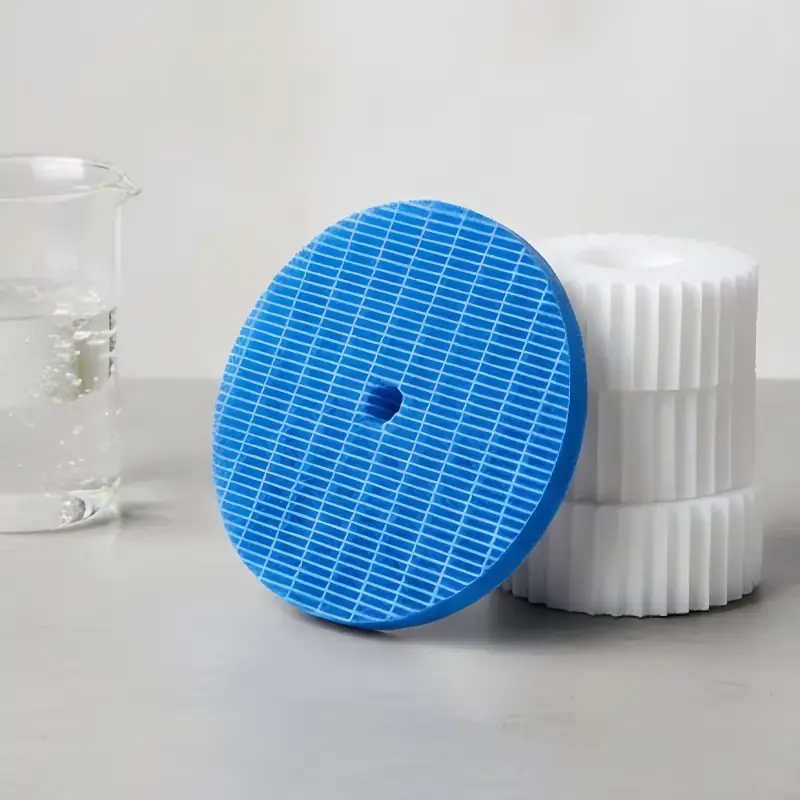
A close-up of a composite humidifier wick designed for maximum capillary action.
Key Specs to Compare When Choosing
When searching for a humidifier wick filter replacement, don't just grab the cheapest option. Compare these technical specifications to ensure you're getting a product that protects your air quality.
1. Material Composition
Wick filters are generally made from three types of materials:
- Paper/Cellulose: Common in budget filters. They wick well initially but tend to lose their shape and sag when wet.
- Textile/Synthetic: More durable and resistant to tearing.
- Composite Fibres: The industry standard for high-end humidifiers. These combine the absorption of plant fibers with the structural integrity of synthetic mesh. At Nantong Deli, we utilize a specialized composite that maintains its 3D structure even after months of use.
2. Capacity (Liters/Day)
The "capacity" of a filter refers to how much water it can help evaporate in a 24-hour period. This is determined by the total surface area. More folds (pleats) in the filter mean more surface area and higher output.
3. Antimicrobial Treatment
Since the filter remains wet for long periods, it is susceptible to mold growth. Look for filters that explicitly state they have antimicrobial or bacteriostatic coatings. These treatments inhibit the growth of bacteria and mold, keeping the air you breathe fresh and odor-free.
4. Mineral Retention & White-Dust Control
While often confused with air-purifier micron ratings, evaporative wick filters act as a physical sacrificial mineral trap. As water rises by capillary action and evaporates into pure vapor, dissolved calcium and magnesium ions remain inside the fiber matrix rather than being nebulized into the room as ultrasonic "white dust" (see our dedicated Humidifier White Dust Engineering Guide).
5. Structural Geometry & Transit Recovery (Field Benchmark: WF813 Format)
For OEM buyers and private-label distributors, physical structure determines both transit survival and wet service life. Mainstream compact cool-mist wicks—such as the widely distributed WF813 / PCWF813 format used in ReliOn (RCM-832 / RCM-832N), ProCare (PCCM-832N / PCCM-840), Duracraft (DH-830 / DH-832) and Equate (EQWF813) humidifiers—use a multi-layer hydrophilic honeycomb mesh construction. As demonstrated in independent product hands-on inspections (see 4-Pack WF813 Humidifier Wick Filter Cool Mist Review — KG Simple Reviews on YouTube), porous honeycomb mesh pads packed in multi-packs can experience minor elastic compression during shipping (with retail listings citing nominal ranges around 3.58"–3.75" W × 5.5"–5.9" H × 1.5"–1.6" D) and are gently pulled by hand to restore full cell opening before installation.
When qualifying an OEM factory, distinguish between reversible transit compression on soft mesh pads and irreversible wet sagging during operation. Nantong Deli addresses wet collapse through synthetic structural-fiber blending, optional internal aluminum support layers, and our patented Folded Composite Cartridge (2024) vertical-rigidity design.
When to Replace Your Humidifier Filter
Running a humidifier with a dirty filter is counterproductive. Not only does it work harder to push air through a clogged filter, but it can also become a source of indoor air pollution. Here are the clear signs you need a replacement:
The "Crusty" Test
If you touch the filter and it feels hard or brittle rather than soft and fibrous, it's time to change it. This "crustiness" is a buildup of calcium and other minerals that block the water from wicking properly.
- Reduced Output: If you find you're refilling the water tank less often than usual, it means the filter isn't wicking water into the air efficiently.
- Discoloration: Filters will naturally turn yellow or brown over time as they trap minerals. Once they are dark brown or have visible black spots (mold), discard them immediately.
- Odors: A "musty" or "fishy" smell coming from your humidifier is a sign of bacterial growth on the wick.
General Guideline: Replace your filter every 1 to 3 months. If you use distilled water, you might reach 3 months; with hard tap water, you may need a fresh filter every 30 days.
Compatible Models Table
Finding the right fit is crucial. A filter that is too small will allow air to bypass the media, while one that is too large may get crushed, reducing its effectiveness. Below are some of the most common models we support with our high-quality OEM replacements.
| Brand | Compatible Model / Filter Part # | Filter Type |
|---|---|---|
| Honeywell | HC-14, HC-888, HFT600, HAC-700 | Tower & Console Wicks |
| Vornado | MD1-0002, WH1-0021 | Evaporative Panel |
| Stadler Form | Oskar, Oskar Little, Oskar Big | Antibacterial Wick |
| Boneco / Air-O-Swiss | W2055, 7531, 7533 | Composite Cartridge |
| Crane | EE-5951, EE-5301 | Cool Mist Wick |
| Holmes / Bionaire | HWF62 (Type A), HWF64/BWF64 (Type B), HWF65 (Type C), HWF75 (Type D), HWF100 (Type E), HWF80-U (Type W) | Drum & Flat Wicks (DL-WK-HWF62 / DL-WK-HWF64) |
| AIRCARE / Essick Air | MAF1, MAF2, 1040, 1041, 1043, 1044, 1045, HDC1, HDC12, HDC2R/311/411 | SuperWick Console & Pedestal (Full 14-Part Table) |
| Aprilaire | Water Panel 35, 45, 110 (Models 300, 350, 360, 500, 550, 600, 700) | Whole-House Evaporator Panel (DL-WK-APR35) |
| Levoit / Philips / ReliOn | Levoit Superior 6000S & Sprout; Philips FY3401/00 & HU4102/01; ReliOn/ProCare WF813 / PCWF813 | Folded Wick, NanoCloud Honeycomb & Multi-Layer Mesh (Full Matrix) |
Note: Browse the complete 20-series SKU mapping in our Brand Compatibility & OEM Cross-Reference Matrix, or view our OEM capabilities here.
OEM & Bulk Sourcing: Why Choose Nantong Deli?
Founded in 1993, Nantong Deli Purification Equipment Co., Ltd. has spent over three decades perfecting air and water filtration technology. For businesses looking for reliable bulk sourcing, we offer several unique advantages:
- Innovation Leader: We hold 53 national patents for filter construction and material science.
- Quality Assurance: We are a National High-Tech Enterprise with ISO 9001:2015 and ISO 14001 certifications.
- Global Reach: Our filters are exported to over 50 countries, meeting diverse environmental standards.
- Fast Prototyping: We offer 7-day sample delivery for custom OEM/ODM designs.
- Scalability: With 80 specialized staff and advanced production lines, we handle everything from niche orders to massive retail distributions.
Beyond humidifier wicks, we also manufacture HAF dehumidifier filters, aluminium mesh filters, and activated carbon filters, providing a one-stop shop for air purification manufacturers.
Frequently Asked Questions
What is the best material for a humidifier wick filter?
The best material is typically a high-density composite of plant fibre and textile fibre. This combination offers the best balance of rapid wicking (water absorption) and structural durability, while also being receptive to anti-microbial treatments.
How often should I change my evaporative humidifier filter?
Ideally, every 1 to 3 months. If you use hard water or run the humidifier 24/7, you should check it every 30 days. Signs for replacement include a crusty texture (mineral buildup), yellow/brown discoloration, or a drop in humidity levels.
Can I wash and reuse a humidifier wick filter?
Generally, no. Most wick filters are made of paper-like fibers that lose their structural integrity and wicking capability once the pores are clogged with minerals. Washing may remove some surface dust but won't restore the filter's performance.
What does an antimicrobial treatment on a filter do?
It inhibits the growth of mold, mildew, and odor-causing bacteria on the filter. Since the filter is constantly wet, it is a prime breeding ground for microbes; treated filters keep the air and the water tank cleaner for longer.
How do I find the right size filter for my humidifier?
Check your humidifier's model number or the part number listed in the manual. You can also measure the height, width, and thickness of your current filter. At Nantong Deli, we provide cross-reference charts for major brands like Honeywell, Vornado, and Stadler Form.
Related Reading
-
Humidifier Wick Filter OEM Manufacturer
Custom replacement wick filters for Honeywell, Vornado, Boneco, Crane and private-label brands.
-
Antimicrobial Humidifier Wick Filters: The Complete 2026 Guide
How antimicrobial treatment works and what to look for when evaluating OEM wick replacements.
-
Humidifier Wick Filter Replacement Guide
How often to replace, what signs to watch for, and how replacement intervals affect indoor humidity.
Upgrade Your Filtration Today
Whether you need a single replacement or a bulk shipment of 10,000 units, Nantong Deli provides the precision and quality your air demands. Get a custom quote or request a sample in minutes.